


Cone beam computed tomography (CBCT)
Precision in 3D
What is cone beam computed tomography?
Cone beam computed tomography (CBCT) is an imaging technique that has revolutionised diagnostics in the oral, jaw and facial area. In contrast to conventional two-dimensional X-rays, CBCT provides precise 3D images of your facial skeleton. You can think of it as a virtual tour through your anatomy: we can view bones, teeth and sensitive nerve pathways from every angle. For you as a patient, this means that diagnoses are more accurate and treatments more plannable than ever before. Decisions and explanations are easier to follow.
The key facts at a glance: why cone beam CT (CBCT)?
Cone beam computed tomography (CBCT) is a advanced three-dimensional imaging technique developed specifically for precise diagnostics in the oral, jaw and facial area. In contrast to conventional 2D X-rays, CBCT produces a detailed 3D data set of the facial skeleton.
A major benefit of CBCT technology is the significantly lower radiation exposure compared with classic computed tomography (CT). At the same time, CBCT offers considerably higher detail resolution of bony structures, enabling an excellent assessment of the finest details.
For patients, 3D diagnostics mean a maximum degree of safety. Because nerve pathways, root canals and bone density are visualised to within a millimetre, risks during surgical procedures can be minimised and complications avoided in advance.
In modern oral and maxillofacial surgery, CBCT has become indispensable. It forms the foundation for computer-assisted planning of dental implants, the performance of complex jaw repositioning (orthognathic surgery) and the safe removal of displaced wisdom teeth or the assessment of the airspace and the airways.
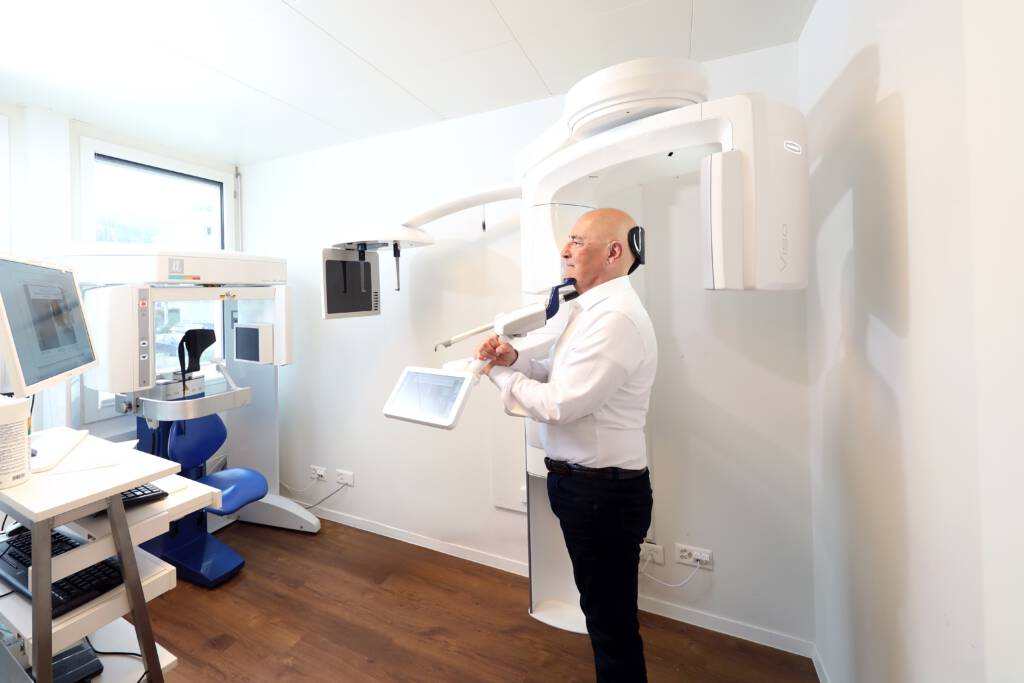
The examination is carried out in an open, patient-friendly position (standing or sitting), takes only a few seconds and avoids the feeling of confinement in the “tube” that is often dreaded with conventional CT scanners.
Why we rely on the most modern and powerful CBCT imaging system for 3D diagnostics
At our practice for oral, maxillofacial, facial and plastic surgery in the Zurich / Lake Zurich region we use: Planmeca Viso® G7 – currently the most modern and powerful CBCT imaging system on the market.
- Precise surgical planning: Even before the first incision, we can see exactly where nerves run or how much bone substance is available, e.g. for an implant.
- Low radiation exposure: CBCT was developed specifically for the head area. Compared with classic computed tomography (CT), the radiation exposure is many times lower. We adjust the radiation individually, dosed as low as possible and only as much as is diagnostically necessary.
- Speed and comfort: The scan takes only a few seconds. You sit or stand comfortably in an open device – feelings of confinement, such as can arise in a "tube" (CT/MRI), are completely eliminated.
- Decision-making certainty for patients: The three-dimensional representation of the anatomical situation enables us to explain planned procedures to patients clearly and in detail.
- AI-supported visualisation of anatomical structures and spaces (volumes, nerves, etc.)
Areas of use: when is a CBCT necessary?
We use cone beam computed tomography with the Planmeca Viso® G7 whenever the highest precision is decisive for treatment success:
- Implantology: For the exact determination of the available bone and the computer-assisted planning of the implant position.
- Wisdom tooth surgery: When roots lie very close to the main nerves of the lower jaw, the 3D view minimises the risk of nerve injuries.
- Sleep apnoea & airways: CBCT enables us to carry out a precise volume analysis of the upper airways to localise the causes of breathing pauses anatomically.
- Jaw surgery & facial planning: For repositioning operations, CBCT is the basis for virtual surgical simulation to achieve functional and aesthetic perfection.
Your path to a reliable diagnosis
Precise treatment begins with a clear picture. If you are facing a surgical procedure or would like a second opinion on a complex issue, CBCT offers the most reliable basis. In a personal consultation, we will happily explain what 3D diagnostics can do for you.